
Where AI in thought leadership is going next
.jpg)
.
.png)
The current hype surrounding AI primarily focuses on the big four large language models (LLMs): OpenAI's ChatGPT, Google's Gemini, Anthropic's Claude, or Meta’s Llama. For many corporate B2B marketers, one of these LLMs is the first, and typically the only, entry point into AI.
You can do a lot with ChatGPT, but there is now an increasingly broad range of specialist AI-based tools that can support your research and content production, often in ways that are not viable for most human teams.
We’ve got a new ebook out that profiles and categorises 50 different tools for B2B thought leadership teams. These tools cover a wide range of applications: including identifying a relevant topic for your brand, supporting your qualitative and quantitative research processes, scaling up your content amplification and distribution, and improving your brand’s visibility within AI search.
From tactical efficiency to strategic innovation
In researching these tools, my colleague Rob and I have seen that they can be mapped across four main areas, as shown on the chart. In the bottom left quadrant is where many companies are focussed today: using AI to enhance productivity and efficiency, but quite tactically focussed on existing thought leadership assets, processes and models.
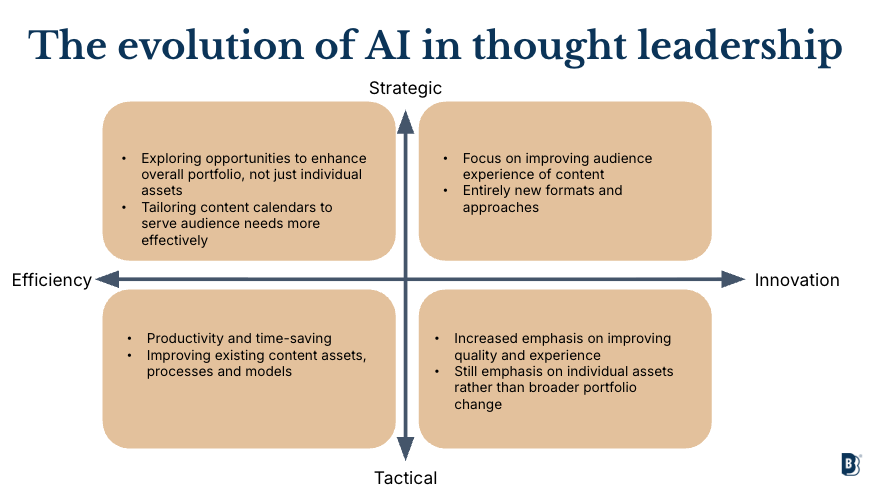
Tools like Jasper, Writer and Copy.ai are useful examples in this space. They are very effective at converting your core messaging into multiple forms of content for varying channels and audiences. Creating landing pages, prospecting emails, social media captions and so on. An important caveat here: we don’t advocate any AI tool being used to actually create the core messaging and viewpoint for your brand - you need to own that.
As companies get more comfortable with AI, they may start to innovate more. In the bottom right quadrant, they start to look at ways to improve the audience experience and quality, while remaining focussed on individual content assets.
For example, companies might start using AI to help turn their insights and messaging into wholly different formats, such as audio or video. Just as the internet lowered the cost of publishing and broadcasting to zero, we’re now seeing the same shift happen in the production of multimedia content. It means that marketers can use tools like Hey Gen or Synthesia create tailored videos for a key target account they’re seeking to reach. Or they might localise and translate their messaging for other markets or audiences that might simply have been too small or niche to cater to before.
On the top left quadrant, marketers start to use AI to improve the overall portfolio of content they’re creating. They’re using this to reshape content calendars, and the types of content being produced.
Here, they might use AI to help personalise the content they’re creating for their audiences, such as newsletters or email campaigns. What would be too labour intensive for a human team, in terms of personalising hundreds or thousands of messages, is now relatively easy using AI. Alternatively, they might use AI to help answer a wide range of very specific or niche questions that their audience might be interested in, but which previously would have been uneconomic to produce.
Towards new kinds of interactions
Finally, the top right quadrant is where we believe marketers will start to explore next. Here, there’s an emphasis on creating entirely new experiences and new ways for audiences to access and experience your content.
As BuzzFeed CEO Jonah Peretti has pointed out, a poor application of GenAI is to use it to create static articles - using a new medium to mimic a legacy format. Rather, it can be most powerful when using it to create wholly new kinds of interactions. At BuzzFeed, this has meant consumer engagement around chatbot-based games and so-called infinity quizzes.
One B2B example of this in action can be seen is the Ask McKinsey AI chatbot, which provides audiences with answers to the questions that matter to them, based on the consulting firm’s rich pool of insights. This pilot remains limited at this point, but it’s an example of where companies might seek to make use of AI to create new ways of interacting with audiences.
In the world of B2C, Coca-Cola led a really interesting ad campaign which was inspired by some of their advertising from nearly a century ago. To complement these ads, the company also created an AI-based digital twin of their 1931 Santa character. This digital twin allowed people to have a conversation with Santa and ask him questions, or to share their wishlists, in an interactive way. You could chat to Santa in any major language, and it all helped to bring the experience of Christmas to life in a new way. When AI is applied to new experiences like this, audiences are much less obsessed about the question of whether it’s made by humans or not.
Of course, we’ve got to work out how best to tackle this all in a B2B context. That’s an interesting challenge we hope to explore further in 2026.
For more on this, feel free to watch the reply of our latest webinar: Is AI the saviour or destroyer of thought leadership?